

Why Do We Like Sad Music?
We look before and after, / And pine for what is not: / Our sincerest laughter / With some pain is fraught; / Our sweetest songs are those that tell of saddest thought. — P.B. Shelley
 Why on earth do people like sad movies? Or listen to sad music? Maybe you yourself are even one of these individuals who does this—do you have any insight into the basis for your decision?
As crazy as it may seem to want to maintain feelings of sadness, this isn’t an occasional or strictly anecdotal occurrence. People do this. Regularly. And in trying to figure out why people may do this, like always, research comes to the rescue.
SAD CHOICES
In general, people regulate (i.e., try to control) their emotions to feel good. Indeed, one of the primary reasons people use drugs, engage in risky behaviors, and do things that otherwise seem reckless or short-sighted is all in order “to feel good.”
Why then do people choose to listen to sad music or watch sad movies?
In one study, researchers brought in participants who scored both low and high on the Beck Depression Inventory (BDI; one of the primary questionnaires to determine people’s depressive symptoms). People who score low on the BDI are relatively happy, while those who score high on the BDI are relatively sad.
Participants then had the option to listen to one of six songs, two of which elicited happiness, two of which elicited sadness, and another two that were relatively neutral. And as you may have guessed from the title of today’s post:
Sad participants (i.e., those scoring high on the BDI) largely preferred listening to sad music compared to the other types of songs (see the percentage breakdowns in the graph to the right).
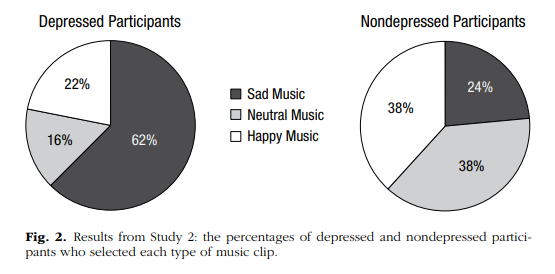 This effect was also replicated on a picture selection task, where sad (vs. happy) participants more frequently chose to spend more time looking at sad (vs. happy) images.
But now, we still have the question of why?
THE ALLURE OF SADNESS
When we feel sad, what’s one of the first things people tend to say to you? “Oh, don’t feel sad. Things will get better/It wasn’t that big of a deal/Stop being overdramatic/etc.”
In other words, when we feel sad, there is a tendency for others to invalidate or fail to affirm the sad emotions we’re feeling. But this validation is important.
 In one study, researchers put participants in either a sad or neutral mood by having them first read either a sad or neutral article (i.e., the sad article was about a natural disaster on a small village in Africa, while the neutral one was about an urban development project in Chicago). Then, the researchers gave participants a persuasive message in support for an increase to the city’s sales tax.
Importantly, this persuasive appeal was framed either in terms of sadness or anger.
Afterward, the researchers found that sad participants were more persuaded by the saddening (vs. angering) message, because it validated (or gave confidence to) the thoughts they were generating. In other words, when we’re sad, listening to sad music or watching a sad movie can help validate the emotions we’re feeling. And by affirming (even embracing) these emotions, it actually makes us feel better.
In fact, when another team of researchers replicated the first study I talked about (i.e., the one where sad people preferred sad music), they followed up with participants to discover something interesting:
Sad participants who chose to listen to sad songs reported greater happiness and less sadness afterward. Moreover, when the participants were personally interviewed about why they made this choice, the most commonly reported reason was that it calmed them.
By validating people’s current emotional state—even if that is a negative one like sorrow—it can improve one’s overall appraisal of their emotions, leading to more calming, positive feelings.
 LIFETIME MOVIES FOR LIFE

So, the next time you’re a little sorrowful and feel yourself turning to Lifetime or Hallmark or that Sarah McLachlan song for sheltered dogs and cats, don’t worry, you’re not crazy. In fact, you may be making the rational choice. But, if someone gives you grief for such a decision, just point them to this blog post. You have science on your side ????
Not Currently Sad But Now Knowingly Can Help It,
jdt
Everyday Psychology: Have you ever wanted to feel sad? Although we may use sad music or movies to help validate our already sorrowful emotions, why would anyone–who’s in a happy mood already–desire to watch a sad movie or listen to a sad song? I would love to hear your speculation on this phenomenon, and I’ll be sure to respond with some thoughts of my own!
DeSteno, D., Petty, R. E., Rucker, D. D., Wegener, D. T., & Braverman, J. (2004). Discrete emotions and persuasion: the role of emotion-induced expectancies. Journal of personality and social psychology, 86(1), 43.
Millgram, Y., Joormann, J., Huppert, J. D., & Tamir, M. (2015). Sad as a matter of choice? Emotion-regulation goals in depression. Psychological Science, 26(8), 1216-1228.
Yoon, S., Verona, E., Schlauch, R., Schneider, S., & Rottenberg, J. (2019). Why do depressed people prefer sad music?. Emotion.